
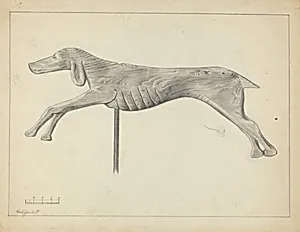
Running Dog Weather Vane
1935/1942
Medium
graphite on paper
Dimensions
overall: 22.1 x 28.1 cm (8 11/16 x 11 1/16 in.) Original IAD Object: 28" long; 10 1/2" high
Classification
Index of American Design
Department
CG-W
Museum
National Gallery of Art, Washington, D.C.
Credit
Index of American Design
Accession Number
1943.8.17507
Rights
Public Domain
Art Historical Context
Behold the *Running Dog Weather Vane a captivating graphite drawing by Gordon San, created between 1935 and1942. This precise rendering, measuring 22.1 x 28.1 cm, captures the dynamic form of a traditional American folk art weather vane—originally 28 inches long and 10½ inches high—depicting sleek dog in mid-stride. Sanborn's lines evoke the vane's sculptural grace, highlighting its role as both functional rooftop sentinel and whimsical artistic expression. As part of the Index of American Design (IAD), housed in the National Gallery of Art's CG-W department, this work stems from a groundbreaking Works Progress Administration (WPA) project during the Great Depression. Launched in 1935, the IAD commissioned artists to document everyday American objects, preserving the nation's folk art heritage amid economic hardship. Weather vanes like this "running dog" exemplified colonial and 19th-century craftsmanship, often hand-forged from metal to spin with the wind, signaling weather changes while adorning barns and homes. Sanborn's graphite technique shines in its fine detail and subtle shading, faithfully reproducing the original's contours and likely weathered patina. This drawing not only celebrates vernacular design but also underscores the IAD's cultural mission: safeguarding symbols of American ingenuity for future generations. A delightful glimpse into our shared past!
About the Artist
Gordon Sanborn · 1855–present
Gordon Sanborn is an artist whose work appears in museum collections in notable quantity, though the biographical details that would situate him within a specific tradition, school, or national context have not been well preserved in the available record. His name suggests an English-speaking background, and the volume of work attributed to him points to a career of real substance, even if the spe...