
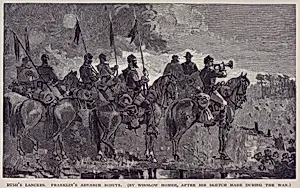
Rush's Lancers. Franklin's Advance Scouts, from The Century Magazine, May 1886
1886
Medium
Graphic Arts-Print
Classification
Graphic Arts-Print
Department
Smithsonian Collection
Museum
Smithsonian American Art Museum
Credit
Smithsonian American Art Museum, The Ray Austrian Collection, gift of Beatrice L. Austrian, Caryl A. Austrian and James A. Austrian
Accession Number
1996.63.221
Rights
Public Domain
Tags
Art Historical Context
Step into the charged world of the American Civil War with Winslow Homer'sRush's Lancers.'s Advance Scouts*, a vivid 1886 wood engraving published in *The Century Magazine*. This dynamic print captures Union cavalrymen from the 6th Pennsylvania Cavalry—known as Rush's Lancerscharging forward as advance scouts under General William B. Franklin. Clad in striking blue uniforms, the soldiers grip lances and signal with trumpets atop rearing horses, evoking the raw energy and peril of wartime reconnaissance. Homer, a master of Realism renowned for his Civil War sketches in *Harper's Weekly*, brings historical precision to this postwar tribute. Featured in *The Century*'s influential "Battles and Leaders of the Civil War" series, the artwork commemorates the Lancers' daring role in campaigns like the Peninsula Campaign, blending eyewitness authenticity with dramatic composition to honor Union valor two decades after Appomattox. As a graphic arts print from the Smithsonian American Art Museum's Ray Austrian Collection, it highlights the era's innovative magazine illustration techniques—fine wood engravings that made epic history accessible to everyday readers. Homer's keen observation of horseflesh, motion, and human grit underscores his legacy in American art, inviting us to reflect on the bravery behind the sabers.
About the Artist
Winslow Homer · 1836–1910
Winslow Homer (1836-1910) was one of America's greatest painters and a preeminent figure in 19th-century American art. Largely self-taught, Homer began his career as a commercial illustrator and Civil War correspondent for Harper's Weekly before becoming renowned for his powerful marine subjects and landscape paintings. His mastery of both oil and watercolor, combined with his uncompromising reali...