
Russians (Oroshiajin)
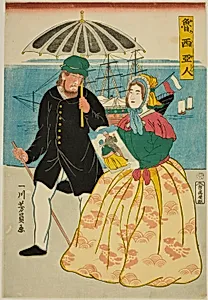
Medium
Color woodblock print; oban
Classification
woodblock print
Department
Arts of Asia
Museum
Art Institute of Chicago
Accession Number
32303
Rights
Public Domain
Art Historical Context
**Russians (Oroshiajin)**, a captivating color woodblock print by Utagawa Yoshik from 1861, exemplifies vibrant ukiyo-e tradition of Japan's Edo period. Produced in the standard oban size—roughly 10 by 15 inches—this belongs to the Utagawa school's legacy of depicting everyday life, theater, and emerging global encounters. Yoshikazu, in the mid-19th century, captured transient scenes with bold colors and dynamic compositions, making prints like this accessible to a wide audience through affordable multiples. Created during the turbulent Bakumatsu era, as Japan ended over two centuries of sakoku (national isolation) following Commodore Perry's arrival in 1853, the print portrays Russians—known as "Oroshiajin"—arriving amid growing foreign trade. Yokohama-e prints like this fueled public fascination with Westerners' exotic attire, ships, and customs, blending curiosity with subtle nationalism in a time of rapid modernization. The woodblock technique shines here: intricate carving on multiple blocks allowed layered colors and fine details, from fur-trimmed coats to expressive faces. Housed in the Art Institute of Chicago's Arts of Asia department, this piece highlights ukiyo-e's role in documenting cultural exchange, offering visitors a window into Japan's pivotal shift toward globalization.
About the Artist
Utagawa Yoshikazu · 1845–1870
Utagawa Yoshikazu (active circa 1850–1870) was a Japanese ukiyo-e woodblock print artist who came of age during one of the most dynamic periods in Japanese history — the twilight of the Edo period and the dawning of the Meiji era. Born and active in Edo (present-day Tokyo), he trained under the celebrated master Utagawa Kuniyoshi, one of the towering figures of the Utagawa school renowned for his ...