
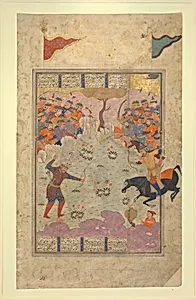
"Rustam Fighting Ashkabus", Folio from a Shahnama (Book of Kings)
1560–80
Medium
Opaque watercolor, silver, and gold on paper
Dimensions
Page: H. 14 5/8 in. (37.1 cm) W. 8 7/8 in. (22.5 cm) Painting: H. 12 1/2 in. (31.8 cm) W. 8 in. (20.3 cm)
Classification
Codices
Department
Islamic Art
Museum
Metropolitan Museum of Art, New York, NY
Credit
Purchase, Rogers Fund and Joseph V. McMullan Gift, 1965
Accession Number
65.7.4
Rights
Public Domain
Tags
Art Historical Context
Behold *Rustam Fighting Ashk*, a vibrant folio from a *Shahnama* (Book of Kings), the epic Persian poem by Abu'l Qasim Firda completed around 1010 CE. This dynamic scene captures the legendary heroam in fierce combat against the demon Ashkabus, pivotal moment from the poem's tales of ancient Iranian kings and champions. Produced between 1560 and 1580 during the Safavid dynasty in Iran, it exemplifies the golden age of Persian manuscript illustration, where storytelling blended poetry with exquisite visuals for royal patrons. Crafted with opaque watercolor, silver, and gold on paper, the artwork showcases the refined techniques of Persian miniature painting. Intricate details—galloping horses, fluttering flags, drawn bows, and arrows—bring the battle to life in a flattened, vibrant composition typical of the style. The lavish use of gold for highlights and silver for accents evokes a sense of otherworldly drama, while the page's dimensions (14 5/8 x 8 7/8 inches) reflect the intimate scale of codices meant for close contemplation. Housed in the Metropolitan Museum of Art's Islamic Art department, this folio highlights the *Shahnama*'s enduring cultural role as a cornerstone of Persian identity, preserving myths of heroism and monarchy. Its acquisition in 1965 underscores its rarity, offering visitors a window into Safavid artistry's splendor.
About the Artist
Abu'l Qasim Firdausi · 935–1020
Abu'l Qasim Firdausi, born around 940 in the village of Paj near Tus in Khorasan (modern-day Iran), emerged from a family of landed gentry known as dehqans, who preserved ancient Iranian oral traditions amid the cultural renaissance of the Samanid Empire. Little is documented about his early life or formal training, though he likely received a basic education including Arabic literacy, immersing h...