
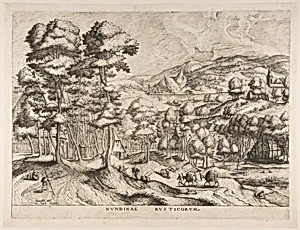
Rustic Market (Nundinae Rusticorum) from The Large Landscapes
Medium
Etching and engraving; second state of three
Dimensions
Sheet: 13 9/16 x 17 11/16 in (34.4 x 44.9 cm) Plate: 11 3/4 x 16 11/16 in (29.8 x 42.4 cm)
Classification
Prints
Department
Drawings and Prints
Museum
Metropolitan Museum of Art, New York, NY
Credit
Harris Brisbane Dick Fund, 1926
Accession Number
26.72.55
Rights
Public Domain
Tags
Art Historical Context
Step into the vibrant world of Pieter Bruegel the Elder's *Rustic Market (Nundinae Rusticorum)* a captivating print from his *Large Landscapes* series, created around 1555–56. Designed by the masterful Netherlandish artist Bruegel, renowned for his intricate depictions of peasant life and expansive vistas, it was expertly translated into etching and engraving by the van Doetecum brothersJohannes and Lucas—and published by Hieronymus. This second state of measures an impressive 13 9/16 x 17 11/16 inches, showcasing the technical precision of 16th-century printmaking. The scene bursts with energy: a bustling rural marketplace nestled amid towering mountains, lush trees, and scattered human figures and animals. Bruegel's panoramic composition captures the everyday rhythm of country folk trading goods, herding livestock, and gathering under the open sky, blending meticulous detail with a sense of boundless space. This reflects his innovative style in the Northern Renaissance, elevating humble rural scenes to poetic grandeur. As part of *The Large Landscapes*, this print played a key role in disseminating Bruegel's groundbreaking vision across Europe, making grand-scale landscapes accessible beyond paintings. Housed in the Metropolitan Museum of Art's Drawings and Prints department (Harris Brisbane Dick Fund, 1926), it invites us to savor the lively spirit of 16th-century countryside life.
About the Artist
Pieter Bruegel the Elder|Johannes van Doetecum I|Lucas van Doetecum|Hieronymus Cock · 1525–1569
Pieter Bruegel the Elder, a pioneering Netherlandish painter of the Renaissance, was born around 1525–1530, likely in Breda in the Duchy of Brabant (present-day Netherlands). Little is known of his early family background, but he apprenticed under the Antwerp painter and designer Pieter Coecke van Aelst between approximately 1545 and 1550, mastering tapestry design, architecture, and painting tech...