
S. Anthonis Marckt met de Waegh
17th century
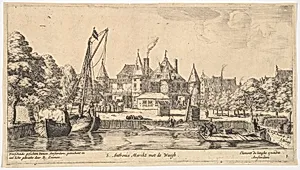
Medium
Etching; state III
Dimensions
sheet: 5 1/2 x 9 7/8 in. (14 x 25.1 cm)
Classification
Prints
Department
Drawings and Prints
Museum
Metropolitan Museum of Art, New York, NY
Credit
Gift of Florance Waterbury in memory of John I. Waterbury, 1968
Accession Number
68.724.48
Rights
Public Domain
Tags
Art Historical Context
Step into the vibrant bustle of 17th-century Amsterdam with *S. Anthonis Marckt met de Waegh* (St. Anthony's Market with the Weigh House an etching by Reinier Nooms, known Zeeman ("sailor"). This lively scene captures the heart of the Dutch city's thriving trade hub, where merchants, boats, and grand buildings converge along the canals. Nooms, a master of maritime and urban views during the Dutch Golden Age, skillfully renders the architectural details of the Weigh House—a key site for commerce—and the teeming market activity, evoking the era's economic prosperity. As a state III etching, this print represents a refined later edition of Nooms' plate, showcasing his etching technique: fine, incisive lines that convey texture, depth, and movement with remarkable precision. Etchings like this were revolutionary for their reproducibility, allowing detailed cityscapes to reach wider audiences beyond paintings. Nooms' style blends topographic accuracy with atmospheric energy, highlighting Amsterdam's role as a global trading powerhouse fueled by the Dutch East India Company. Today, this 5 1/2 x 9 7/8-inch gem resides in the Metropolitan Museum of Art's Drawings and Prints department, a gift from Florance Waterbury in memory of John I. Waterbury (1968). It offers visitors a window into everyday Golden Age life, where boats laden with goods symbolize the ingenuity and ambition that defined the Netherlands.
About the Artist
Reinier Nooms, called Zeeman · 1623–1664
Reinier Nooms, known as Zeeman ("sailor" in Dutch), was a prominent Dutch maritime painter, draftsman, and etcher of the Golden Age, born around 1623 or 1624 in Amsterdam and dying there in 1664 at about age 40. Before turning to art around 1643, he led a rough life as a professional seaman, which informed his unparalleled accuracy in depicting ships, ports, naval battles, and coastal scenes—knowl...