
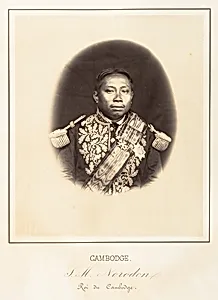
S. M. Norodon, Roi du Cambodge
1866
Medium
Albumen silver prints from glass negatives
Dimensions
23.3 x 19.7 cm (9 3/16 x 7 3/4 in.)
Classification
Photographs
Department
Photographs
Museum
Metropolitan Museum of Art, New York, NY
Credit
Gilman Collection, Purchase, The Horace W. Goldsmith Foundation Gift, through Joyce and Robert Menschel, 2005
Accession Number
2005.100.501 (42)
Rights
Public Domain
Tags
Art Historical Context
In 1866, French photographer Émile Gsell captured this striking portrait of S. M. Norodom, King of Cambodia (r. 1860–1904), using the albumen silver print process from glass negatives. Measuring 23.3 x 19.7 cm, the image belongs to the Metropolitan Museum of Art's Photographs Department, part of the renowned Gilman Collection. G, a pioneering figure in 19th-century colonial photography, documented Southeast Asia while based in Saigon, making this one of the earliest known photographs of a Cambodian monarch. The albumen process, dominant in the 1850s–1890s, produced richly toned prints with exceptional detail, ideal for formal portraits like this one. Norodom's regal pose and attire reflect Khmer royal traditions, yet the photograph marks a pivotal moment: Cambodia had become a French protectorate in 1863, blending indigenous sovereignty with emerging colonial documentation. This work holds cultural significance as a window into Cambodia's history during European expansion. Gsell's images helped shape Western perceptions of Asian royalty, preserving Norodom's likeness amid rapid political change. Visitors will appreciate its technical precision and the intimate glimpse into a king's world.
About the Artist
Emile Gsell · 1838–1879
Emile Gsell (1838–1879) was a French photographer who became one of the earliest Western photographers to document Southeast Asia, particularly the ancient temples of Angkor in Cambodia. Born in Sainte-Marie-aux-Mines in Alsace, France, Gsell traveled to Indochina in the 1860s, establishing a photographic studio in Saigon (present-day Ho Chi Minh City) that became a base for his documentary expedi...