
S. Pierre Regalda (S. Pietro d'Alcantara)
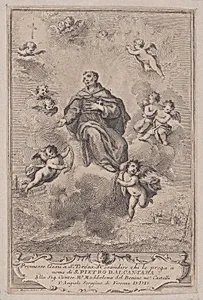
Medium
Etching and engraving; third state
Dimensions
Sheet: 11 in. × 7 3/8 in. (28 × 18.8 cm)
Classification
Prints
Department
Drawings and Prints
Museum
Metropolitan Museum of Art, New York, NY
Credit
The Elisha Whittelsey Collection, The Elisha Whittelsey Fund, 1962
Accession Number
62.661.37
Rights
Public Domain
Art Historical Context
Francesco Bartolozzi's *S. Pierre Regalda (S Pietro d'Alcantara, created in 1746, the likeness of Saint Peter of Alcara, a revered 16th-century Spanish Franciscanar known for his ascetic life, mysticism, and reforms within the Discalced Carmelites. At just 18 years old the young Italian engraver Bartolozzi produced this etching and engraving from Florence, where he trained under eminent artists. This early work exemplifies his precocious talent in reproductive printmaking, a booming field in 18th-century Europe that made religious icons accessible to the faithful beyond grand altarpieces. The print's medium—etching combined with fine engraving in its third state—highlights Bartolozzi's technical mastery. Etching allowed fluid, spontaneous lines, while engraving added precise tonal depth and detail, common in multi-state prints refined over impressions. Measuring 11 x 7 3/8 inches, it was ideal for personal devotion or scholarly collections, reflecting the era's Catholic revival and growing market for affordable sacred art. Housed in the Metropolitan Museum of Art's Elisha Whittelsey Collection (acquired 1962), this piece underscores Bartolozzi's foundational role in printmaking. Later celebrated for his stipple technique in England, his youthful depiction of the saint invites visitors to appreciate how intricate craftsmanship preserved spiritual legacies for generations.
About the Artist
Francesco Bartolozzi · 1727–1815
Francesco Bartolozzi (1727–1815) was an Italian engraver whose most productive period was spent in London, where he became the leading exponent of stipple engraving and a founding member of the Royal Academy. Born in Florence and trained first as a painter before turning to engraving in Venice, he established his reputation in Rome before being recruited by the English Royal Librarian Richard Dalt...