
Sabrina
1856
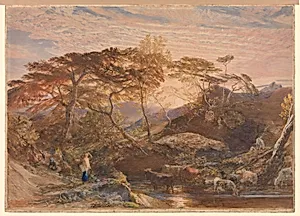
Medium
Watercolor and gouache (bodycolor) over graphite, with reductive techniques, shell gold and gum arabic
Dimensions
Sheet: 21 15/16 × 30 1/8 in. (55.7 × 76.5 cm)
Classification
Drawings
Department
Drawings and Prints
Museum
Metropolitan Museum of Art, New York, NY
Credit
Purchase, Acquisitions Fund and David T. Schiff Gift, 2017
Accession Number
2017.252
Rights
Public Domain
Tags
Art Historical Context
Samuel Palmer's *Sabrina* (1856) is a luminous watercolor and gouache masterpiece, evoking the mythical nymph from John Milton's *Comus*. This late work by the visionary British artist captures a pastoral landscape teeming with human figures, animals, rolling hills, and ancient trees, blending classical mythology with Palmer's deep love for the English countryside. Palmer, a key figure in the Romantic "Ancients" circle influenced by William Blake, shifted in his later years to intricate, jewel-like watercolors that celebrated nature's spiritual harmony. Executed on a grand sheet (21 15/16 × 30 1/8 in.), the artwork employs graphite underdrawing for precise composition, layered with opaque gouache (bodycolor) for rich depth. Palmer's reductive techniques—scratching away pigment to reveal glowing highlights—mimic sunlight filtering through foliage, while shell gold adds ethereal sparkle and gum arabic enhances vibrancy and adhesion. These methods underscore watercolor's transformative power, turning fluid washes into a tapestry of light and shadow. Acquired by the Metropolitan Museum of Art in 2017, *Sabrina* exemplifies Palmer's enduring legacy in British landscape art, bridging Romantic idealism with Pre-Raphaelite precision. Visitors will delight in its enchanting narrative, inviting reflection on humanity's bond with the natural world.
About the Artist
Samuel Palmer · 1805–1881
Samuel Palmer was born on 27 January 1805 in Newington, London, the son of a bookseller and sometime Baptist minister. He had little formal schooling and almost no conventional artistic training, yet he possessed an instinctive gift for drawing that led him to exhibit Turner-inspired works at the Royal Academy when he was only fourteen years old. In 1824 his mentor, the painter John Linnell, intro...