
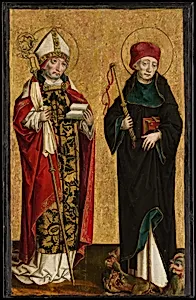
Saint Adalbert and Saint Procopius
ca. 1490–1500
Medium
Oil on spruce, gold ground
Dimensions
Painted surface, including black border, 27 1/8 x 17 in. (68.9 x 43.2 cm)
Classification
Paintings
Department
European Paintings
Museum
Metropolitan Museum of Art, New York, NY
Credit
Gift of William Rosenwald, 1944
Accession Number
44.147.1
Rights
Public Domain
Tags
Art Historical Context
In the late 15th century, anonymous *Master of Eggenburg*named after an altarpiece in Lower Austria—created this luminous panel painting, *Saint Adalbert and Saint Procopius (ca. 1490–1500). Depicting two revered Central European saints, the work captures Adalbert, the Bohemian bishop and missionary martyred in 997 while evangelizing the Prussians and Procopius, 11th-century Czech hermit and abbot of Sázava. These holy men, patrons of the region, stand frontally against a shimmering gold ground, their solemn gazes and richly brocaded robes evoking devotion in a time when such images adorned church altars. Painted in oil on spruce wood—a durable panel favored in Northern Europe—the gold ground technique harks back to medieval traditions, infusing the saints with a divine glow and symbolic heavenliness. This late Gothic style bridges the ornate detail of the Middle Ages and the emerging realism of the Renaissance, with meticulous rendering of folds, jewels, and halos showcasing the master's skill. Measuring about 27 by 17 inches, the intimate scale suggests it was part of a larger polyptych, inviting personal prayer. A generous gift to the Metropolitan Museum of Art from William Rosenwald in 1944, this panel offers a window into Habsburg-era piety, where saints like Adalbert and Procopius embodied faith amid cultural and political shifts in Bohemia and Austria. Visitors will appreciate its preserved vibrancy, a testament to enduring spiritual artistry.