
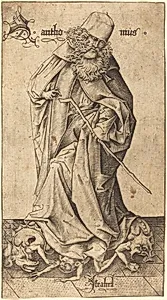
Saint Anthony
1401 to 1500
Medium
engraving
Classification
Department
CG-E
Museum
National Gallery of Art, Washington, D.C.
Credit
Rosenwald Collection
Accession Number
1943.3.132
Rights
Public Domain
Art Historical Context
Israhel van Meckenem's *Saint Anthony*, an engraving from the late 15th century (circa 1401–1500), captures the revered Desert Father in a moment of quiet devotion. As a leading German printmaker of the Northern Renaissance, van Meckenem was renowned for his intricate engravings that bridged late Gothic traditions with emerging Renaissance naturalism. Housed in the National Gallery of Art's Rosenwald Collection (Department CG-E), this print exemplifies his mastery of fine lines and detailed textures, achieved through the burin on copper plates. Engraving as a medium revolutionized art dissemination in 15th-century Europe, allowing affordable reproductions of religious imagery for pilgrims and the devout. Van Meckenem's style features meticulous cross-hatching for depth and shading, evoking the saint's spiritual aura amid sparse desert motifs. Saint Anthony, patron of hermits and those afflicted by skin diseases, often appears with symbolic elements like a staff or bell, underscoring themes of temptation and faith that resonated during an era of religious fervor and plague. This work highlights printmaking's cultural role in democratizing sacred art, making van Meckenem's visions accessible beyond elite patrons. A testament to Northern Europe's artistic innovation, it invites visitors to appreciate the delicate precision that brought holiness to everyday life.
About the Artist
Israhel van Meckenem · 1435–1503
Israhel van Meckenem (c. 1445–1503), also known as Israhel van Meckenem the Younger, was a pioneering German engraver and goldsmith based in Bocholt, near the Dutch border, renowned as the most prolific printmaker of the fifteenth century. Born into a family possibly of Dutch origin, he was the son of Israhel van Meckenem the Elder, a goldsmith who settled in Bocholt in 1457. He trained initially ...