
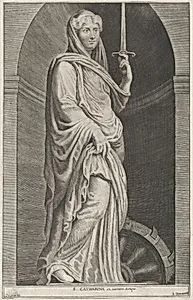
Saint Catherine, within a niche
Medium
Engraving; only state
Dimensions
Sheet (Trimmed): 11 5/16 × 7 1/4 in. (28.7 × 18.4 cm)
Classification
Prints
Department
Drawings and Prints
Museum
Metropolitan Museum of Art, New York, NY
Credit
The Elisha Whittelsey Collection, The Elisha Whittelsey Fund, 1951
Accession Number
51.501.7161
Rights
Public Domain
Tags
Art Historical Context
This engraving of Saint Catherine, created between 1615 and 1675 by Lucas Vorsterman I in collaboration with Peter Paul Rubens, captures the saint within an architectural niche. Vorsterman, a skilled Flemish printmaker, translated Rubens’s dynamic compositions into the precise lines of engraving, a medium prized during the Baroque era for its ability to reproduce and widely distribute images of religious subjects. The work’s single state indicates it was printed without later alterations, preserving the original design in its purest form. Saint Catherine is shown with her traditional attributes, including swords, symbols of her martyrdom. The niche framing evokes a sculptural presence, blending printmaking with the illusion of three-dimensional devotional art. Rubens’s influence is evident in the dramatic pose and rich detail, characteristic of the Flemish Baroque style that emphasized movement, emotion, and spiritual intensity. Acquired by the Metropolitan Museum of Art through the Elisha Whittelsey Fund in 1951, this print highlights the important role of reproductive engravings in spreading Counter-Reformation imagery across Europe. Its modest scale—roughly 11 by 7 inches—made such works accessible for private devotion while showcasing the technical mastery of early seventeenth-century printmaking.