
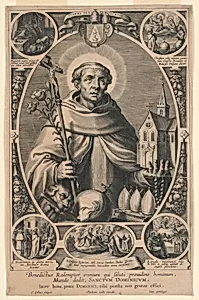
Saint Dominic
Classification
religion
Department
Smithsonian Collection
Museum
Smithsonian American Art Museum
Credit
Bequest of George Campbell Cooper
Accession Number
1896-3-112
Rights
Public Domain
About this artwork
Research in Progress
Art Historical Context
Cornelis Galle I (1576–1650), a prominent Flemish engraver Antwerp, created *Saint Dominic* around 1630. As part of the renowned Galle family of printmakers, Galle specialized in intricate engravings that often reproduced designs by leading Baroque masters like Peter Paul Rubens. Though the medium of this work remains unidentified amid ongoing research, Galle's expertise suggests a finely detailed print, capturing the saint in a style reflective of Flanders' vibrant 17th-century artistic scene. Saint Dominic, founder of the Dominican Order, embodies piety and scholarly devotion, making him a fitting subject for religious art during the Counter-Reformation. This period saw Flemish artists producing devotional images to inspire faith amid religious tensions in Europe. Galle's portrayal likely emphasizes the saint's contemplative aura, aligning with Baroque tendencies toward dramatic expression and spiritual intensity. Housed in the Smithsonian American Art Museum through the bequest of George Campbell Cooper, *Saint Dominic* offers a window into the technical mastery of Flemish engraving and its role in disseminating Catholic iconography. Visitors can appreciate how such works bridged elite patronage and popular devotion, preserving sacred narratives for generations.