
Saint Emericus
1516/1518
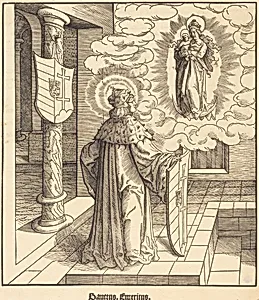
Medium
woodcut
Classification
Department
CG-E
Museum
National Gallery of Art, Washington, D.C.
Credit
Rosenwald Collection
Accession Number
1964.8.307
Rights
Public Domain
Art Historical Context
Leonhard Beck’s “Saint Emericus,” a woodcut created between 1516 and 1518, offers a vivid glimpse into the vibrant world of early sixteenth-century German printmaking. Beck, active in Augsburg, was among the skilled artists who helped transform woodcut from a craft into a refined artistic medium capable of conveying both spiritual devotion and intricate detail. The technique itself—carving designs into wooden blocks for repeated printing—made images like this accessible beyond church walls, allowing religious subjects to reach a wider public during the Reformation era. The subject, Saint Emericus (also known as Emeric of Hungary), was a revered eleventh-century prince canonized for his piety and chastity. Beck renders him with the dignity befitting a saintly role model, using the bold contrasts and crisp lines characteristic of woodcut to emphasize his regal yet humble presence. Such prints often served devotional purposes, inviting viewers to reflect on virtues of faith and noble conduct. Now part of the National Gallery of Art’s Rosenwald Collection, this work underscores the lasting cultural importance of prints in preserving and sharing religious narratives across centuries.
About the Artist
Leonhard Beck · 1480–1542
Leonhard Beck (c. 1480–1542) was a prominent painter, draftsman, and woodcut designer active in Augsburg, Germany, during the early Renaissance. Born into an artistic family, he was the son of the miniaturist Georg Beck, with whom he collaborated on two psalters for an Augsburg monastery around 1495. Beck began his training as an apprentice in the workshop of the esteemed Augsburg painter Hans Hol...