
Saint Francis
Medium
Engraving
Dimensions
Plate: 5 7/8 × 4 3/16 in. (14.9 × 10.7 cm) Sheet: 5 7/8 × 4 5/16 in. (15 × 10.9 cm)
Classification
Prints
Department
Drawings and Prints
Museum
Metropolitan Museum of Art, New York, NY
Credit
Harris Brisbane Dick Fund, 1953
Accession Number
53.601.13(196)
Rights
Public Domain
Tags
Art Historical Context
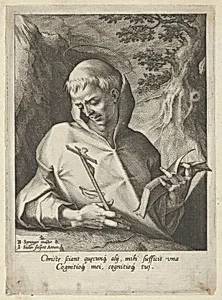
This engraving of Saint Francis, created around 1582, captures the revered saint in a moment of quiet devotion, his figure intertwined with the cross that symbolized his spiritual life. Johann Sadeler I, a skilled Flemish printmaker, translated a design by Bartholomeus Spranger into this intimate plate. Spranger, a leading figure in Northern Mannerist circles, served at the court of Emperor Rudolf II in Prague, where elongated forms and elegant poses defined the era’s sophisticated style. As an engraving, the work exemplifies the medium’s vital role in the late Renaissance, allowing religious imagery to circulate widely beyond churches and palaces. Fine lines and subtle shading convey both the saint’s humility and the dramatic intensity characteristic of Mannerism, bridging Italian influences with Northern European traditions during the Counter-Reformation. Today housed in the Metropolitan Museum’s collection, this modest yet refined print highlights how collaborative efforts between painters and engravers shaped devotional art for a broader audience. Its compact scale invites close viewing, rewarding observers with delicate details that speak to both faith and artistic refinement.
About the Artist
Johann Sadeler I|Bartholomeus Spranger · 1550–1601
**Johann Sadeler I (also known as Jan or Johannes Sadeler), born in Brussels in 1550 and active until his death in Venice in 1600, stands as a pivotal figure in the Sadeler family, the most prolific dynasty of Flemish engravers and print publishers in Northern Europe during the late sixteenth and early seventeenth centuries.** As the eldest of three brothers—including Aegidius I and Raphael I—he ...