
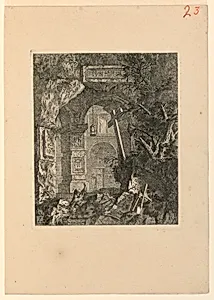
Saint-Francois (?) dans un paysage de ruines
1768, published 1770
Classification
architecture
Department
Smithsonian Collection
Museum
Smithsonian American Art Museum
Credit
Gift of Whitney Warren
Accession Number
1958-136-1-w
Rights
Public Domain
About this artwork
Research in Progress
Art Historical Context
**Saint-Francois (?) un paysage de ruines** *Jean-Laurent LegeayFrench, ca. 1710–86), 1768 (published 1770)*Jean-Laurent Legeay, a architect and engraver active in Rome during the mid-18th century, this intriguing work amid the Enlightenment's fascination with antiquity. Titled *Saint-Francois (?) dans paysage de ruines*suggesting a tentative depiction of Saint Francis amid crumbling structures—it exemplifies Legeay's specialty in architectural capriccios. These imaginative compositions blended real ruins with fantastical elements, reflecting the era's Romantic interest in decay as a metaphor for time's passage and human impermanence. Classified within architecture, the piece likely captures the grandeur and melancholy of ancient Roman remnants, a theme Legeay explored through precise engravings that influenced later picturesque landscapes. Created in 1768 and published in 1770, it arrived at the Smithsonian American Art Museum as a gift from Whitney Warren, part of ongoing research into its nuances. Though details like the exact medium remain under study, the work invites visitors to ponder how 18th-century artists romanticized ruins, bridging neoclassical precision with emotional depth. (178 words)