
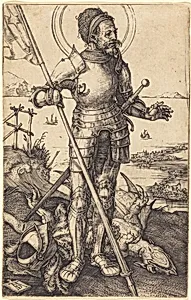
Saint George Standing
c. 1502/1503
Medium
engraving on laid paper
Dimensions
sheet (trimmed to plate): 11.2 × 7.1 cm (4 7/16 × 2 13/16 in.)
Classification
Department
CG-E
Museum
National Gallery of Art, Washington, D.C.
Credit
Rosenwald Collection
Accession Number
1943.3.3495
Rights
Public Domain
Art Historical Context
Behold Albrecht Dürer's *Saint George Standing* (c. 1502/1503), a engraving on laid paper measuring just 11.2 × 7.1 cm. Created during the Northern Renaissance, this intimate print captures the legendary dragon-slayer in a poised, triumphant stance, emblematic of chivalric ideals and Christian valor. Dürer, the Nuremberg genius who bridged German precision with Italian humanism, produced this at the height of his career, following his transformative travels to Venice. Dürer's engraving technique shines here: using a burin to incise fine lines into a copper plate, he achieved extraordinary detail in the saint's armor, flowing cape, and subtle landscape backdrop—all within a tiny format. This method allowed for multiple impressions, making high art accessible beyond elite patrons and revolutionizing printmaking as a democratic medium. Housed in the National Gallery of Art's Rosenwald Collection (Department CG-E), this work exemplifies Dürer's enduring legacy. Its crisp lines and dynamic composition invite viewers to marvel at how a small sheet conveys epic heroism, reminding us of Saint George's role as protector against evil in medieval lore. A true gem for print enthusiasts!
About the Artist
Albrecht Dürer · 1471–1528
Albrecht Dürer (1471–1528) stands as the preeminent figure of the Northern Renaissance and arguably the most influential artist in the history of printmaking. Born in Nuremberg on May 21, 1471, and dying in the same city on April 6, 1528, Dürer revolutionized the status of the artist in Northern Europe, transforming printmaking from a commercial craft into an independent fine art and establishing ...