
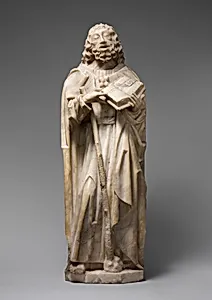
Saint James the Lesser
ca. 1500
Medium
Alabaster
Dimensions
Overall: 29 x 9 11/16 x 7 1/4 in. (73.6 x 24.6 x 18.4 cm)
Classification
Sculpture-Stone|Sculpture-Alabaster
Culture
Spanish
Department
Medieval Art
Museum
Metropolitan Museum of Art, New York, NY
Credit
Gift of J. Pierpont Morgan, 1916
Accession Number
16.32.153
Rights
Public Domain
Art Historical Context
**Saint James the Lesser** by Gil de Siloe, around 1500, stands as masterful example of Spanish alabaster sculpture from the cusp of the Gothic and Renaissance eras. This life-sized figure (29 x 9⅝ x 7¼ inches) captures the apostle in contemplative pose, embodying the devotional art popular in late medieval Spain. Siloe, a Flemish-trained sculptor active in Burgos, blended intricate Northern European detail with emerging Renaissance naturalism, as seen in his contributions to grand altarpieces like the one at the Cartuja de Miraflores. Alabaster's soft, translucent quality allowed Siloe to achieve delicate textures—flowing robes, expressive hands, and subtle facial serenity—that evoke spiritual depth. Such sculptures were often part of church ensembles, inviting pilgrims to venerate saints like James the Lesser, one of Christ's lesser-known apostles, whose humility resonated in Iberian Catholic devotion amid the Reconquista's fervor. Today, this poignant work graces the Metropolitan Museum of Art's Medieval Art department, a 1916 gift from J. Pierpont Morgan. It highlights Spain's artistic bridge between medieval piety and humanistic ideals, offering visitors a tactile glimpse into 15th-century faith and craftsmanship.