
Saint Jerome
Medium
Engraving
Dimensions
Plate: 6 3/8 × 4 5/8 in. (16.2 × 11.8 cm) Sheet: 6 9/16 × 4 3/4 in. (16.6 × 12.1 cm)
Classification
Prints
Department
Drawings and Prints
Museum
Metropolitan Museum of Art, New York, NY
Credit
Harris Brisbane Dick Fund, 1953
Accession Number
53.601.13(202)
Rights
Public Domain
Tags
Art Historical Context
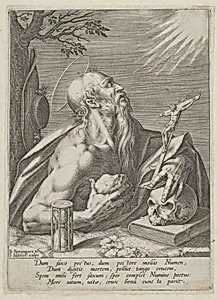
This engraving of Saint Jerome, created between 1568 and 1600, reflects the fruitful collaboration between Flemish painter Bartholomeus Spranger and master engraver Johann Sadeler I. Spranger, known for his elegant Mannerist figures, provided the design that Sadeler translated into this intimate print. The medium of engraving was especially significant during this period, allowing religious imagery to reach a broad audience across Europe through affordable, reproducible works. The composition centers on Saint Jerome, the early Christian scholar and translator, accompanied by symbols of mortality and devotion such as skulls and the Crucifixion. These elements underscore themes of penitence, study, and faith that resonated deeply in the late Renaissance. The small scale—roughly the size of a postcard—invites close, personal contemplation, a hallmark of devotional prints from the era. Housed in the Metropolitan Museum of Art’s Department of Drawings and Prints, this work exemplifies how Northern European artists blended Italianate grace with Northern attention to detail. Acquired through the Harris Brisbane Dick Fund in 1953, it remains a fine example of how prints preserved and disseminated spiritual narratives for centuries.
About the Artist
Johann Sadeler I|Bartholomeus Spranger · 1550–1601
**Johann Sadeler I (also known as Jan or Johannes Sadeler), born in Brussels in 1550 and active until his death in Venice in 1600, stands as a pivotal figure in the Sadeler family, the most prolific dynasty of Flemish engravers and print publishers in Northern Europe during the late sixteenth and early seventeenth centuries.** As the eldest of three brothers—including Aegidius I and Raphael I—he ...