
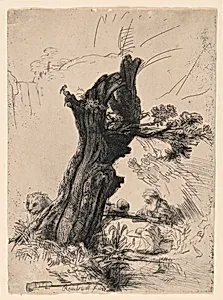
Saint Jerome Beside a Pollard Willow
Medium
Classification
Department
Smithsonian Collection
Museum
Smithsonian American Art Museum
Credit
Bequest of George Campbell Cooper
Accession Number
1896-3-162
Rights
Public Domain
About this artwork
Research in Progress
Art Historical Context
In the hallowed tradition of Baroque artistry, Rembrandt Harmensz van Rijn captures the contemplative solitude of *Saint Jerome Beside a Pollard Willow* in this 1648 etching. The Dutch master's depiction of the 4th-century scholar-saint—patron of translators and librarians—places him in a serene landscape dominated by the gnarled, pollard willow, a tree deliberately pruned to encourage vigorous new growth. This humble print, from the Smithsonian American Art Museum's collection (bequest of George Campbell Cooper), reflects Rembrandt's fascination with religious introspection during the Dutch Golden Age, a time of prosperity and profound spiritual inquiry in the Netherlands. Rembrandt's genius shines in his printmaking prowess, revolutionizing etching with intricate drypoint lines and subtle tonal gradations that mimic the chiaroscuro effects of his oil paintings. Here, light filters through the willow's branches, illuminating Jerome's weathered form and evoking themes of penance, wisdom, and renewal—hallmarks of the Counter-Reformation era. Produced amid Rembrandt's peak productivity in Amsterdam, this work exemplifies his ability to infuse intimate, human-scale narratives with monumental emotional depth. Though research continues, this rare print offers visitors a window into Rembrandt's technical innovation and enduring legacy, bridging 17th-century devotion with modern appreciation for masterful draftsmanship.