
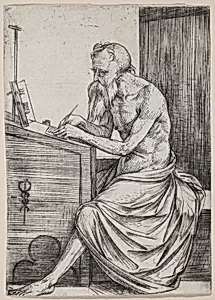
Saint Jerome
c. 1501/1504
Medium
engraving on laid paper
Dimensions
sheet (trimmed within plate mark): 8.4 x 5.9 cm (3 5/16 x 2 5/16 in.)
Classification
Department
CG-E
Museum
National Gallery of Art, Washington, D.C.
Credit
Ailsa Mellon Bruce Fund
Accession Number
1989.18.1
Rights
Public Domain
Art Historical Context
Jacopo de' Barbari's "Saint Jerome," created around 1501–1504, is a finely detailed engraving on laid paper. At just 8.4 by 5.9 centimeters, the print's intimate scale encourages close viewing, where the precise lines etched into the copper plate come to life. This technique, still relatively in the early sixteenth century, allowed artists to reproduce images with remarkable clarity and share them beyond a single location. De' Barbari, a Venetian artist who worked across northern Europe, used engraving to capture the scholarly saint in a moment of quiet reflection. The medium itself marks an important shift in Renaissance art, enabling wider circulation of religious subjects among collectors and scholars. Such prints often served both devotional and educational purposes, bridging the worlds of faith and learning. Acquired through the Ailsa Mellon Bruce Fund, this work now resides in the National Gallery of Art's collection of prints. It offers today's visitors a tangible connection to the period's artistic innovations and the timeless appeal of Saint Jerome as a symbol of wisdom and contemplation.
About the Artist
Jacopo de' Barbari · 1497–1516
Jacopo de' Barbari (c. 1460/70–before 1516) was an Italian painter, printmaker, and miniaturist of Venetian background whose career unfolded across the courts and workshops of northern Europe, making him one of the most important conduits between Italian Renaissance art and the northern artistic tradition in the years around 1500. Little is known of his training or his early decades; Alvise Vivari...