
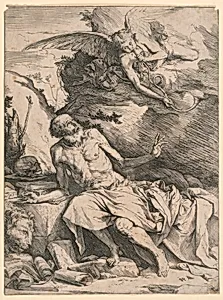
Saint Jerome
Classification
figures
Department
Smithsonian Collection
Museum
Smithsonian American Art Museum
Credit
Smithsonian American Art Museum
Accession Number
1896-31-13
Rights
Public Domain
About this artwork
Research in Progress
Art Historical Context
Jusepe de Rib, a Spanish artist who spent much of his career in Naples, Italy, masterfully captured the intensity of religious devotion in *Saint Jerome* around 1620. Born in 1591, Ribera a leading figure in the Neapolitan Baroque, influenced by Caravaggio's dramatic tenebrism—harsh contrasts of light and shadow that heighten emotional depth. This painting, classified as a figure study and housed in the Smithsonian American Art's collection, reflects his early maturity during a time when Naples was under Spanish rule, blending Iberian spirituality with Italian realism. Saint Jerome, the 4th-century scholar and Doctor of the Church, is a favored subject for Baroque artists, often shown as a penitent hermit in the wilderness, contemplating mortality with symbols like a skull or lion. Ribera's interpretation likely emphasizes the saint's rugged humanity—veined skin, muscular form, and introspective gaze—showcasing his signature naturalism drawn from life studies. Though the medium remains unidentified amid ongoing research, such works highlight Ribera's innovative approach to flesh tones and psychological insight. As part of the Smithsonian's treasures, *Saint Jerome* invites visitors to ponder the Baroque era's fusion of faith and artistry, bridging Spanish and Italian traditions. Its presence underscores Ribera's enduring legacy as "Lo Spagnoletto" (the Little Spaniard), whose unflinching realism continues to captivate.