
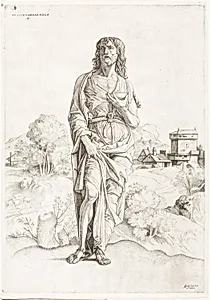
Saint John the Baptist
c. 1505
Medium
Engraving in black on ivory laid paper
Dimensions
Plate: 34.2 × 23.8 cm (13 1/2 × 9 3/8 in.); Sheet: 35.6 × 24.7 cm (14 1/16 × 9 3/4 in.)
Classification
engraving
Department
Prints and Drawings
Museum
Art Institute of Chicago
Accession Number
18602
Rights
Public Domain
About this artwork
Active in Venice, where he learned to generate the diffuse, smoky effects characteristic of his teacher Giorgione, the painter and printmaker Giulio Campagnola is best remembered for his engraving. The artist invented the stipple engraving technique seen here, which was especially popular for reproductions in the 18th and 19th centuries, and he produced this work almost entirely out of dots and flecks. Silhouetting the hard-edged figure of John against a stark white background, Campagnola also r...
Art Historical Context
**Saint John the Baptist** *Giulio Campagnola,. 1505* Engraving in black on ivory laid paper *Art Institute of Chicago, Prints and Drawings Department* Behold the ascetic figure of Saint John the Baptist rendered with masterful precision by Giulio Campagnola, pioneering Italian engraver active in early 16th-century Venice Dated around 1505, this engraving captures the saint—precursor to Christ—in a moment of profound spirituality, likely evoking his wilderness life with symbolic attributes like the staff or lamb. Campagnola, influenced by Venetian masters such as Giorgione, bridged painting and printmaking, creating images that rivaled the depth of oil canvases. The medium shines here: engraving on ivory laid paper, a fine support that enhances the ink's rich blacks and subtle tones. Campagnola incised intricate lines into a copper plate, achieving delicate modeling through cross-hatching and burr—a technique that built volume and texture, mimicking the sfumato of Renaissance painting. At 34.2 × 23.8 cm, the plate's scale allowed intimate detail, making it ideal for collectors and devotees during the High Renaissance, when prints democratized sacred art. This work exemplifies the era's fusion of religious devotion and technical innovation, circulating biblical narratives far beyond church walls. A testament to Campagnola's legacy, it invites us to trace the saint's gaze, pondering themes of penance and prophecy that resonated in Reformation-tinged Europe.
About the Artist
Giulio Campagnola · 1482–1515
Giulio Campagnola (c. 1482–c. 1515) was born in Padua, within the Republic of Venice, to Girolamo Campagnola, a noted humanist scholar and writer who may have been an amateur painter. Exceptionally gifted from youth, by age fifteen he was praised as a poet, musician, linguist in Latin, Greek, and Hebrew, and skilled in painting, engraving, and gem-cutting, prompting efforts to secure him a positio...