
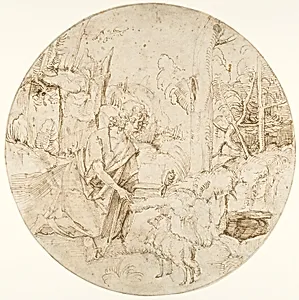
Saint John the Baptist in the Wilderness
ca. 1510–15
Medium
Pen and brown ink with traces of black chalk and brush and gray ink
Dimensions
Diameter: 10 13/16 in. (27.4 cm)
Classification
Drawings
Department
Drawings and Prints
Museum
Metropolitan Museum of Art, New York, NY
Credit
Harris Brisbane Dick Fund, 1953
Accession Number
53.112
Rights
Public Domain
Tags
Art Historical Context
In the early 16th century, Süss von Kulmb, a Nuremberg-based artist influenced by Albrecht Dürer and the School, crafted this exquisite drawing of *Saint John the Baptist the Wilderness* around 1510–15. Rendered in pen and brown ink with subtle traces of black chalk and-added gray ink, the circular composition—measuring 10 13/16 inches in diameter—evokes the intimate scale of a Renaissance study or medallion design. Acquired by the Metropolitan Museum of Art through the Harris Brisbane Dick Fund in 1953, it exemplifies the Northern Renaissance mastery of line and texture on paper. The scene depicts the biblical prophet Saint John the Baptist amid a rugged wilderness, surrounded by grazing sheep and gnarled trees, symbolizing his ascetic life of prophecy and preparation for Christ. Such religious imagery was central to devotional art in Reformation-era Germany, where drawings like this served as preparatory sketches for paintings, prints, or altarpieces, blending spiritual narrative with naturalistic detail. Kulmbach's technique shines in his precise, fluid pen strokes, which capture the woolly texture of sheep, the twist of branches, and atmospheric depth through gray wash. This work highlights the era's shift toward observed nature in art, making it a gem for admirers of intricate draftsmanship and early landscape elements in sacred subjects.