
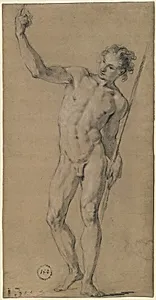
Saint John the Baptist
c. 1717
Medium
black chalk with white heightening on brown paper; laid down
Dimensions
overall: 49.9 x 25.2 cm (19 5/8 x 9 15/16 in.)
Classification
Drawing
Department
CG-E
Museum
National Gallery of Art, Washington, D.C.
Credit
Gift of Neil and Ivan Phillips
Accession Number
1989.42.1
Rights
Public Domain
Art Historical Context
This striking drawing of Saint John the Baptist, created around 1717 by the French artist François Le Moyne, captures the saint in a moment of quiet contemplation. Le Moyne, who would later become a leading figure in the transition from late Baroque to early Rococo painting in France, demonstrates his skill in rendering the human form with sensitivity and grace. The work’s modest scale—roughly 50 by 25 centimeters—suggests it may have served as a preparatory study, allowing the artist to explore pose and lighting before committing to a larger canvas. Executed in black chalk with white heightening on brown paper, the drawing highlights Le Moyne’s masterful use of contrast to model the figure’s anatomy and drapery. The white chalk adds luminous highlights that bring a sculptural quality to the saint’s form, while the warm brown ground provides depth and atmosphere. Such techniques were prized in early eighteenth-century French academies, where drawings were valued not only as steps toward finished paintings but as independent works of art worthy of collection. Today, this sheet resides in the National Gallery of Art thanks to the generosity of Neil and Ivan Phillips. It offers visitors a rare glimpse into the creative process of an artist whose career bridged two major stylistic eras, reminding us of the intimate, tactile nature of draftsmanship in the age before photography.