
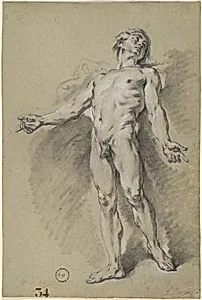
Apollo
c. 1752
Medium
black chalk and stumping, heightened with white chalk on greenish-gray laid paper
Dimensions
overall: 54.4 x 36.5 cm (21 7/16 x 14 3/8 in.)
Classification
Drawing
Department
CG-E
Museum
National Gallery of Art, Washington, D.C.
Credit
Gift of Robert H. and Clarice Smith
Accession Number
1980.64.1
Rights
Public Domain
Art Historical Context
François Boucher's *Apollo* (c. 1752) captures the radiant essence of the Greek sun god in a masterful preparatory drawing, emblematic of the French Rococo style. Boucher, the preeminent painter to Louis XV, was renowned for his elegant, sensual depictions of mythological figures, blending playful eroticism with exquisite decorative flair. Created during the height of Rococo's ornate exuberance in mid-18th-century France this work likely served as a study for a larger painting or tapestry design, showcasing Boucher's skill in evoking divine beauty and movement. Executed in black chalk with stumping—a technique that blends tones for velvety softness—heightened with white chalk on greenish-gray laid paper, the drawing exemplifies 18th-century draftsmanship. The tinted paper provides a subtle mid-tone ground, allowing dramatic highlights to mimic Apollo's glowing form and deep shadows to define muscular contours. Measuring 54.4 x 36.5 cm, its intimate scale invites close appreciation of Boucher's fluid linework and luminous modeling, techniques that influenced generations of artists. Housed in the National Gallery of Art through the generous gift of Robert H. and Clarice Smith, *Apollo* offers a window into Rococo's celebration of classical mythology amid Enlightenment-era refinement, reminding visitors of art's power to immortalize the divine.
About the Artist
François Boucher · 1703–1770
François Boucher (1703–1770) stands as the quintessential master of French Rococo painting and the most celebrated decorative artist of the 18th century. Born in Paris to a lace designer, Boucher created a visual language that perfectly embodied the refined taste, sensuality, and elegance of Louis XV's court. His prolific output—encompassing paintings, tapestry designs, theatrical sets, and decora...