
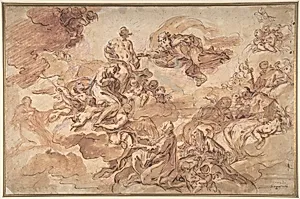
Saint Joseph Presented by the Virgin to the Holy Trinity
ca. 1735
Medium
Red chalk, pen and brown ink, brush and brown wash, highlighted with white
Dimensions
10 5/16 x 15 13/16in. (26.2 x 40.2cm)
Classification
Drawings
Department
Drawings and Prints
Museum
Metropolitan Museum of Art, New York, NY
Credit
Rogers Fund, 1965
Accession Number
65.131.7
Rights
Public Domain
Tags
Art Historical Context
In the opulent world of 18th-century Italian art, Corrado Giaqu's *Saint Joseph Presented by the Virgin the Holy Trinity* (. 1735) captures the grace and drama of the Rococo style. Giaquinto, a Genoese painter renowned for his frescoes andarpieces in Rome and the Spanish court, created this preparatory drawing as a masterful study likely intended for a larger religious painting. Measuring just 10 5/16 x 15 13/16 inches, it exemplifies the intricate planning behind grand Baroque-Rococo commissions, blending spiritual devotion with theatrical flair. Rendered in red chalk for soft modeling, pen and brown ink for precise contours, brush and brown wash for atmospheric depth, and white highlights for luminous effects, the work showcases Giaquinto's virtuoso technique. The composition centers on Saint Joseph, humbly offered by the Virgin Mary to the Holy Trinity, surrounded by angels, putti, and saints—evoking Catholic mysticism and intercession. This mixed-media approach allowed artists like Giaquinto to experiment with light, movement, and emotion before committing to oil or fresco. Housed in the Metropolitan Museum of Art's Drawings and Prints department (Rogers Fund, 1965), this gem highlights the preparatory genius of Rococo masters, offering visitors a rare glimpse into the creative process that adorned Europe's churches and palaces with divine splendor.