
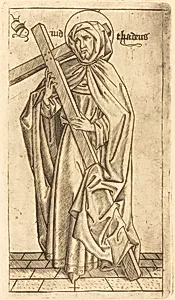
Saint Judas Thaddeus (?) or Saint Simon (?)
c. 1470/1480
Medium
engraving on laid paper
Dimensions
plate: 15.9 × 9 cm (6 1/4 × 3 9/16 in.) sheet: 29.3 × 19.3 cm (11 9/16 × 7 5/8 in.)
Classification
Department
CG-E
Museum
National Gallery of Art, Washington, D.C.
Credit
Rosenwald Collection
Accession Number
1943.3.128
Rights
Public Domain
Art Historical Context
This delicate engraving, tentatively identified as *Saint Judas Thaddeus or Saint Simon (?)**, was created by Israhel vankenem around 1470–1480, closely following the style of the pioneering engraver Master E.S. of the earliest masters of the medium, Master E.S. (active mid-15th century) revolutionized printmaking in the German-speaking regions, producing intricate copperplate engravings that could be reproduced in multiples—making religious art accessible beyond elite patrons. Van Meckenem, a prolific Netherlandish-German artist known for his copies and adaptations, captures the saint in a compact plate of just 15.9 × 9 cm, printed on laid paper. The technique involves incising fine lines into a metal plate with a burin, inking it, and pressing onto paper to yield sharp, detailed images. Here, the saint's haloed figure, likely holding apostolic symbols, exemplifies late Gothic devotional art from the Northern Renaissance, blending spiritual piety with emerging technical precision. Housed in the National Gallery of Art's Rosenwald Collection, this print highlights engraving's role in spreading iconography of lesser-known apostles like Judas Thaddeus (patron of desperate causes) or Simon. Its small scale suggests personal devotion, portable for pilgrims or private altars, bridging medieval manuscript traditions with the print revolution.