
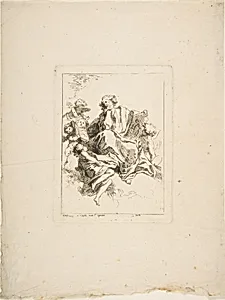
Saint Luke
Medium
Etching, first state of two
Dimensions
Sheet: 9 1/8 × 6 3/4 in. (23.2 × 17.1 cm) Plate: 4 7/8 × 3 5/8 in. (12.4 × 9.2 cm) Image: 4 1/2 x 3 1/8 in. (11.5 x 8 cm)
Classification
Prints
Department
Drawings and Prints
Museum
Metropolitan Museum of Art, New York, NY
Credit
The Elisha Whittelsey Collection, The Elisha Whittelsey Fund, 1957
Accession Number
57.581.32
Rights
Public Domain
Tags
Art Historical Context
Behold *Saint Luke*, a delicate etching by Jean Honoré Fragonard the celebrated French Rococo artist known for his playful, light-filled scenes. Created around 1764 as the first state of two this print reproduces an earlier composition by the Baroque master Giovanni Lanfranco, showcasing Fragonard's skill in translating grand painting into intimate print form. Measuring just 4½ × 3⅛ inches, the image captures the evangelist saint—patron of painters—likely in a moment of inspired contemplation or creation, surrounded by symbols of his gospel-writing and artistic legacy. Etching, Fragonard's chosen medium here, allowed for fine, expressive lines that mimic the fluidity of his brushwork, bridging 17th-century Baroque drama with 18th-century elegance. As a first-state impression from The Metropolitan Museum of Art's Elisha Whittelsey Collection, it retains the raw, unfinished quality prized by collectors, before later states added refinements. This rarity highlights the era's fascination with reproductive prints, which democratized access to old master works. For visitors, *Saint Luke* evokes the reverence artists held for their saintly muse, reminding us how faith and creativity intertwined across centuries. A gem of the Met's Prints department, it invites closer inspection of its intricate details.
About the Artist
Jean Honoré Fragonard|Giovanni Lanfranco · 1732–1806
Jean-Honoré Fragonard (1732-1806) was a French painter and printmaker whose late Rococo manner was distinguished by remarkable facility, exuberance, and hedonism. Born in Grasse, he moved to Paris where he trained under Jean-Baptiste Chardin and François Boucher, winning the prestigious Prix de Rome in 1752. After studying in Italy alongside Hubert Robert, Fragonard returned to Paris in 1761 to fi...