
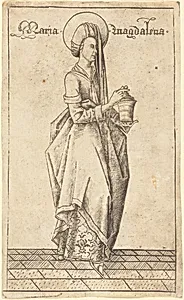
Saint Mary Magdalene
c. 1470
Medium
engraving
Classification
Department
CG-E
Museum
National Gallery of Art, Washington, D.C.
Credit
Rosenwald Collection
Accession Number
1943.3.148
Rights
Public Domain
Art Historical Context
Welcome to the National Gallery of Art, where Israhel van Meckenem *Saint Mary Magdalene* (c. 1470) invites us into the intricate world of late 15th-century Northern printmaking. This engraving, part of the esteemed Rosenwald Collection in the Prints department (CG-E), captures the artist's mastery during the transition from Gothic to Renaissance styles. Meckenem, a prolific engraver from the Rhineland, produced thousands of plates, often blending religious devotion with technical virtuosity. The subject, Saint Mary Magdalene—the biblical figure redeemed through penance—holds deep cultural resonance in medieval Christianity, symbolizing repentance and spiritual transformation. Engravings like this were revolutionary: using a burin to incise fine lines into copper plates, Meckenem created detailed, reproducible images affordable to a wider audience beyond the elite. This democratized art, spreading iconography through homes and workshops. Meckenem's precise line work and tonal shading showcase his skill, influenced by contemporaries like Martin Schongauer. A testament to early graphic innovation, this print highlights how Northern artists elevated engraving into a respected medium, bridging painting and mass imagery. Pause and admire its delicate precision! (198 words)
About the Artist
Israhel van Meckenem · 1435–1503
Israhel van Meckenem (c. 1445–1503), also known as Israhel van Meckenem the Younger, was a pioneering German engraver and goldsmith based in Bocholt, near the Dutch border, renowned as the most prolific printmaker of the fifteenth century. Born into a family possibly of Dutch origin, he was the son of Israhel van Meckenem the Elder, a goldsmith who settled in Bocholt in 1457. He trained initially ...