
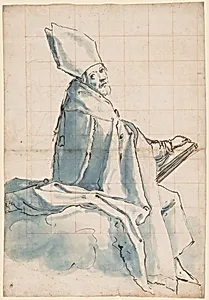
Saint Nicholas of Bari
c. 1610
Medium
pen and brown ink with brush and blue wash, over black chalk, squared in red chalk
Dimensions
sheet: 58.74 × 40.01 cm (23 1/8 × 15 3/4 in.)
Classification
Drawing
Department
CG-E
Museum
National Gallery of Art, Washington, D.C.
Credit
Purchased as the Gift of the Krugman Family Foundation, Ann and Matthew Nimetz, and Robert B. Loper
Accession Number
2018.94.1
Rights
Public Domain
Art Historical Context
This striking preparatory drawing by Jacopo da Empoli captures Saint Nicholas of Bari, the beloved fourth-century bishop known for his generosity and miracles. Created around 1610, the sheet reflects the Flor artist’s careful planning for a larger painting, likely an altarpiece destined for a church setting. Jacopo, active during the transition from late Mannerism to early Baroque, specialized in clear, devotional compositions that emphasized clarity and emotional directness in religious subjects. The drawing’s technique reveals the artist’s working process. Executed in pen and brown ink with blue wash over black chalk, it is squared in red chalk—a grid system that allowed Jacopo to transfer and enlarge the design onto canvas or panel. The blue wash adds subtle modeling and depth, helping visualize how light and shadow would play across the saint’s robes and attributes in the final work. Such highly finished drawings were prized by collectors even in Jacopo’s day. Measuring nearly two feet tall, the sheet demonstrates the monumental scale of Baroque religious art and the central role drawings played in its creation. Today it offers visitors a rare glimpse into the thoughtful, methodical steps behind the dramatic paintings that adorned early seventeenth-century Italian churches.
About the Artist
Jacopo da Empoli · 1544–1640
Jacopo Chimenti, known as Jacopo da Empoli (1551-1640), was an Italian Florentine painter whose long career spanned the transition from late Mannerism to early Baroque. Born in Florence on April 30, 1551 (Empoli being his father's birthplace, from which Jacopo derived his artistic name), he became an important figure in the Counter-Maniera or Counter-Mannerist movement that reacted against the com...