
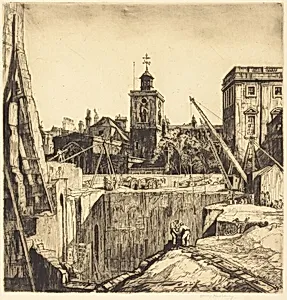
Saint Olave's, Crutched Friars
1914
Medium
drypoint and engraving in black
Dimensions
plate: 276 × 26.1 cm (108 11/16 × 10 1/4 in.)
Classification
Department
CG-W
Museum
National Gallery of Art, Washington, D.C.
Credit
Rosenwald Collection
Accession Number
1943.3.7522
Rights
Public Domain
Art Historical Context
Henry Rushbury's *Saint Olave's,utched Friars* (1914) captures a poignant slice of Edwardian London, depicting the historic church of St. Olave in the Crutched Fri district—a medieval site tied to the city's friars and merchants. Created on the eve of World War, this print reflects Rushbury's fascination with London's architectural heritage, at a time when rapid urbanization threatened such ancient structures. The artist, a prominent British printmaker influenced by McNeill Whistler, was part of the early th-century etching revival, blending meticulous observation with atmospheric subtlety. Executed in drypoint and engraving on a tall, narrow plate (27.6 × 26.1 cm), the work showcases Rushbury's technical mastery. Drypoint's needle-scratched lines produce a soft, velvety burr for rich tonal depth, while engraving's incised precision adds sharp architectural details, evoking the texture of weathered stone and shadowed alleys. Printed in black ink, it emphasizes dramatic contrasts, inviting viewers to linger on the play of light and form. Housed in the National Gallery of Art's Rosenwald Collection, this print highlights Rushbury's role in preserving vanishing urban scenes. Tragically, St. Olave's was later destroyed in the Blitz, making the work a vital historical document of London's enduring spirit. A gem for print enthusiasts, it bridges tradition and modernity with quiet elegance.
About the Artist
Henry Rushbury · 1889–1968
Henry Rushbury was a British artist celebrated primarily for his etchings and watercolors of architectural subjects, working during the early and middle decades of the twentieth century. He studied at the Birmingham School of Art before moving to London, where he became part of a generation of printmakers who revitalized the etching medium in Britain during the years surrounding the First World Wa...