
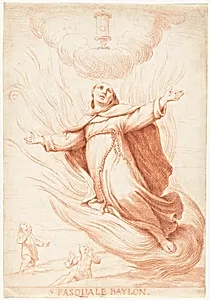
Saint Paschal Baylon in Ecstasy
c. 1700
Medium
red chalk on laid paper
Dimensions
sheet: 23.2 × 16 cm (9 1/8 × 6 5/16 in.)
Classification
Drawing
Department
CG-E
Museum
National Gallery of Art, Washington, D.C.
Credit
William B. O'Neal Fund
Accession Number
2023.50.1
Rights
Public Domain
Art Historical Context
In red chalk drawing on laid paper, a robed Franciscan saint rises weightlessly at the center, his arms outstretched and head tilted upward in rapture. Swirling, energetic lines surround his billowing habit, suggesting motion and divine light, while a small lantern-like form hovers above amid sketched clouds. Below, two diminutive figures kneel and gesture in awe, their smaller scale emphasizing the saint’s elevated state. The artist uses delicate hatching and fluid contours to convey both the texture of fabric and the intensity of spiritual experience. Giuseppe Maria Crespi created this work around 1700, capturing the moment of ecstasy experienced by Saint Paschal Baylon, a seventeenth-century Franciscan known for his devotion to the Eucharist. As a leading Bolognese draftsman of the late Baroque period, Crespi often explored religious themes with lively, expressive technique. The drawing’s intimate scale invites close looking, revealing how the artist transformed a simple chalk sketch into a vivid vision of heavenly transport.
About the Artist
Giuseppe Maria Crespi · 1665–1747
Giuseppe Maria Crespi (1665–1747) was an Italian painter of the late Baroque period whose innovative genre scenes and unorthodox approach to religious painting made him one of the most original artists of early eighteenth-century Bologna. Born in Bologna, he trained under Domenico Maria Canuti, Carlo Cignani, and in the tradition of the Carracci academy, but developed a markedly personal style tha...