
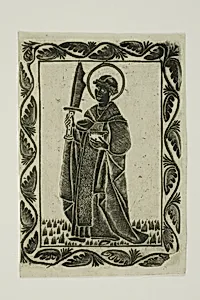
Saint Peter Martyr
c. 1450–60
Medium
Metal cut printed on paper
Dimensions
Plate: 261.7 × 185.5 cm (103 × 73 in.); Sheet: 279.4 × 190.5 cm (110 × 75 in.)
Classification
dotted/metal cut
Department
Prints and Drawings
Museum
Art Institute of Chicago
Accession Number
3675
Rights
Public Domain
Art Historical Context
Behold the monumental *Saint Peter Martyr*, a striking religious print from around 1450–60, created by an unknown artist and now housed in the Art Institute of Chicago's Prints and Drawings Department. This depiction honors Saint Peter of Verona, a 13th-century Dominican friar famed for his zealous preaching against heresy and his dramatic martyrdom—often shown with a dagger embedded in his skull. Produced in the early Renaissance era, it reflects the era's deep devotion to saints as protectors and exemplars of faith, making such images popular for both personal devotion and public display in churches or homes. What sets this work apart is its rare medium: metalcut printed on paper, a pioneering technique where a metal plate was incised to form a relief surface, then dotted for texture and printed. Classified as "dotted/metal cut," it exemplifies a short-lived 15th-century innovation bridging woodcut and engraving, prized for its bold lines and tonal effects achievable without acid etching. Most metalcuts were modest in scale, but this one's vast dimensions—plate measuring over 8 by 6 feet—make it an extraordinary survivor, likely intended as a grand devotional banner or wall hanging. Its cultural significance lies in capturing a pivotal moment in printmaking's evolution, democratizing large-scale religious art when painting was elite. Visitors, marvel at how this fragile yet imposing sheet transports us to a time when faith was vividly, physically present.