
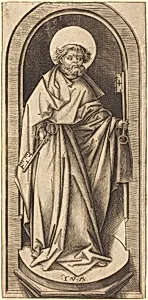
Saint Peter
c. 1490/1503
Medium
engraving
Classification
Department
CG-E
Museum
National Gallery of Art, Washington, D.C.
Credit
Rosenwald Collection
Accession Number
1943.3.130
Rights
Public Domain
Art Historical Context
In the late 15th century, Israhel van Meckenem, a prolific German engraver active in the Rhineland, captured the revered figure of Saint Peter in striking print, dated around 1490 to 1503. As one of the earliest apostles and the traditional first pope, Saint Peter symbolizes the foundations of the Christian Church, often depicted holding the keys to the kingdom of heaven—a motif drawn from Matthew 16:19 in the Bible. Van Meckenem's work reflects the Northern Renaissance's blend of late Gothic detail and emerging realism, where religious devotion met innovative artistry. Engraving, the medium here, was a transformative technique in this era: van Meckenem incised fine lines into a copper plate, inking it to produce multiple impressions on paper. This allowed affordable dissemination of sacred images to pilgrims, clergy, and laypeople across Europe, democratizing art in a time before widespread painting reproduction. Part of the National Gallery of Art's Rosenwald Collection, this print exemplifies van Meckenem's mastery of intricate cross-hatching for texture and depth, showcasing his influences from masters like Martin Schongauer. Today, it invites us to ponder faith's visual power during the cusp of the Reformation, when prints like this bridged medieval piety and Renaissance innovation. A testament to enduring spiritual iconography!
About the Artist
Israhel van Meckenem · 1435–1503
Israhel van Meckenem (c. 1445–1503), also known as Israhel van Meckenem the Younger, was a pioneering German engraver and goldsmith based in Bocholt, near the Dutch border, renowned as the most prolific printmaker of the fifteenth century. Born into a family possibly of Dutch origin, he was the son of Israhel van Meckenem the Elder, a goldsmith who settled in Bocholt in 1457. He trained initially ...