
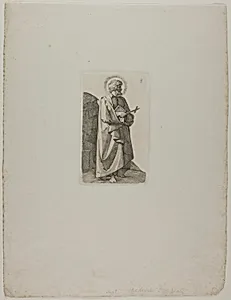
Saint Philipp Neri with Cross and Book
Medium
Etching on wove paper
Dimensions
Image: 13.8 × 8.3 cm (5 7/16 × 3 5/16 in.); Sheet: 36.3 × 27.6 cm (14 5/16 × 10 7/8 in.)
Classification
etching
Department
Prints and Drawings
Museum
Art Institute of Chicago
Accession Number
141443
Rights
Public Domain
Art Historical Context
Johann Friedrich Overbeck's *Saint Philipp Neri with and Book* (1826) captures the spirit of one of Catholicism's most beloved reformers, Saint Philip Neri, founder of the Oratorians known as the "Apostle of Rome" his joyful piety. Rendered as a delicate etching, the work depicts the saint holding a cross and book—symbols of his devotion and scholarly life—evoking a sense of quiet contemplation. Overbeck, a key in the Nazarene movement drew inspiration from early Renaissance masters like Raphael, seeking to revive spiritual purity in art amid the secularism of post-Napoleonic Europe. This etching exemplifies the Nazarenes' commitment to religious themes and meticulous draftsmanship, blending Romantic idealism with medieval simplicity. Overbeck's technique in etching—incising lines into a copper plate with acid—allowed for intricate details in the saint's flowing robes and expressive face, printed on smooth wove paper for crisp reproduction. At just 13.8 × 8.3 cm, the intimate image was ideal for devotional collections, reflecting 19th-century print culture's role in disseminating sacred imagery to the faithful. Housed in the Art Institute of Chicago's Prints and Drawings department, this piece highlights Overbeck's enduring influence on German religious art, bridging Gothic revival and modern printmaking traditions.
About the Artist
Johann Friedrich Overbeck · 1789–1869
**Johann Friedrich Overbeck** (3 July 1789 – 12 November 1869) was a German painter and a founder of the Nazarene movement. Born in Lübeck into a prominent Protestant family—his father, Christian Adolph Overbeck, was a doctor of law, poet, mystic pietist, and burgomaster—he received early classical and artistic instruction at the local Gymnasium under his uncle. Overbeck left Lübeck in 1806 to st...