
Saint Pierre
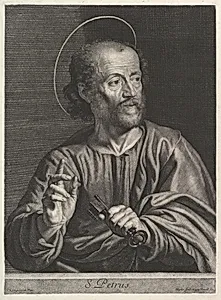
Medium
Etching
Dimensions
sheet: 19 7/8 x 13 5/8 in. (50.5 x 34.6 cm) image: 17 x 12 1/2 in. (43.2 x 31.7 cm)
Classification
Prints
Department
Drawings and Prints
Museum
Metropolitan Museum of Art, New York, NY
Credit
Harris Brisbane Dick Fund, 1945
Accession Number
45.41.54
Rights
Public Domain
Tags
Art Historical Context
Behold *Saint Pierre*, a striking etching attributed to Jean Morin after Philippe de Champaigne housed in the Metropolitan Museum of's Drawings and Prints department This work captures Saint Peter, the apostle and first Pope, symbolized by the keys he holds—representing the "keys to the kingdom of heaven" from the Gospel of Matthew. Champaigne, a leading French Baroque painter known for his austere, classical style influenced by Flemish masters like Rubens, often depicted saints with profound spiritual intensity, while engraver Morin excelled in translating such compositions into prints. Etching, the medium here, involves coating a metal plate with acid-resistant ground, scratching lines through it, and immersing in acid to etch the grooves for inking and printing. Measuring nearly 20 by 14 inches on the sheet, this large-scale print allowed for detailed rendering of Peter's dignified pose and symbolic attributes, making religious imagery accessible beyond original paintings. Morin's reproductive etchings bridged elite art and broader audiences during the 17th century, amid France's Catholic revival. Acquired through the Harris Brisbane Dick Fund in 1945, *Saint Pierre* exemplifies the Met's commitment to preserving masterful prints that illuminate Baroque devotion and printmaking innovation. A testament to faith and artistry, it invites visitors to ponder the enduring power of sacred icons.
About the Artist
Jean Morin|Philippe de Champaigne · 1605–1650
Jean Morin (c. 1605–1650) was one of the most accomplished French engravers of the seventeenth century, a master of the portrait print whose work stands among the finest examples of French graphic art in its era. Little is known about his early life or training, though his technique suggests exposure to both French and Flemish engraving traditions, the latter being the dominant force in European p...