
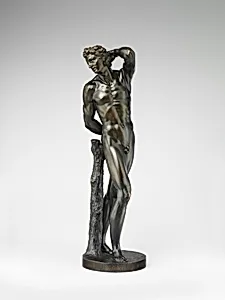
Saint Sebastian
Medium
Bronze
Dimensions
Overall (confirmed): 21 3/8 × 6 3/8 × 6 3/8 in. (54.3 × 16.2 × 16.2 cm)
Classification
Sculpture-Bronze
Culture
Italian, Venice
Department
European Sculpture and Decorative Arts
Museum
Metropolitan Museum of Art, New York, NY
Credit
Samuel D. Lee Fund, 1940
Accession Number
40.24
Rights
Public Domain
Tags
Art Historical Context
**Saint Sebastian** (1566) by Alessandro Vittoria, a leading Venetian sculptor of the Mannerist era, exemplifies the Renaissance fascination with the idealized male nude fused with Christian iconography. Crafted in bronze—a durable medium prized for its rich patina and ability to capture intricate details—this 21⅜-inch figure stands in the Metropolitan Museum of Art's European Sculpture and Decor Arts collection, acquired through the Samuel D. Lee Fund in 1940. Vittoria, born Alessandro Vittoria di Vigilio della Volpa (1525–1608), trained under Jacopo Sansovino and drew inspiration from Michelangelo, blending classical anatomy with elongated, graceful forms characteristic of Mannerism. The sculpture depicts Saint Sebastian, the early Christian martyr famously pierced by arrows yet enduring in faith, a popular subject in 16th-century Venice amid the Counter-Reformation's emphasis on saints' resilience. Vittoria's bronze captures the saint's poised vulnerability, highlighting taut musculature and subtle contrapposto that evoke both suffering and serenity. This work reflects Venice's vibrant bronze-casting tradition, where artists like Vittoria produced devotional pieces for churches and private collections, bridging pagan beauty with spiritual devotion. Visitors will appreciate how this intimate-scale sculpture invites close contemplation of its lifelike texture and emotional depth, a testament to Italian Renaissance innovation in the mid-1500s. (218 words)