
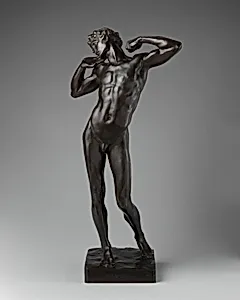
The Sluggard
modeled 1886, cast possibly before 1896
Medium
Bronze, dark olive brown patina
Dimensions
Overall: 20 1/2 × 9 1/8 × 6 1/2 in. (52.1 × 23.2 × 16.5 cm); footprint of base: 5 3/4 × 6 1/2 in. (14.6 × 16.5 cm)
Classification
Sculpture-Bronze
Culture
British, London
Department
European Sculpture and Decorative Arts
Museum
Metropolitan Museum of Art, New York, NY
Credit
Rogers Fund, 1906
Accession Number
06.936
Rights
Public Domain
Tags
Art Historical Context
*The Sluggard* is a captivating bronze sculpture by Frederic, Lord Leighton, a prominent British artist of the Victorian era, modeled in 1886 cast possibly before 1896 by J.W. Singer & Sons. in London. Standing at 20½ inches tall, this reduced-scale work depicts a male nude in a languid, stretching pose—evoking the title's theme of idleness or "sluggardliness." The dark olive brown patina lends it an aged, classical patina, enhancing its timeless appeal and mimicking ancient bronzes revered in 19th-century Europe. Leighton's mastery shines in the fluid anatomy and dynamic contrapposto, capturing a fleeting moment of human relaxation with remarkable realism. As a leading figure in British art, Leighton drew from classical antiquity, blending Renaissance techniques with Victorian sensibilities to celebrate the male form amid a cultural fascination with heroic nudity. Cast in bronze—a durable medium ideal for public and domestic display—this piece exemplifies the era's revival of sculptural traditions. Acquired through the Rogers Fund in 1906 for the Metropolitan Museum of Art's European Sculpture and Decorative Arts collection, *The Sluggard* invites visitors to ponder the beauty in everyday repose, bridging ancient ideals with modern introspection.
About the Artist
Frederic, Lord Leighton|J. W. Singer & Sons Ltd. · 1830–1896
Frederic Leighton, 1st Baron Leighton (1830–1896), was born on 3 December 1830 in Scarborough, England, to a prosperous medical family. His father, Dr. Frederic Septimus Leighton, and mother, Augusta Susan, provided him with financial security throughout his life, while his grandfather, Sir James Boniface Leighton, had served as physician to Russian tsars Alexander I and Nicholas I. After early ed...