
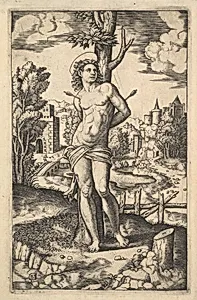
Saint Sebastian tied to a tree pierced by arrows
1530–60
Medium
Engraving
Dimensions
sheet: 9 1/16 x 6 1/8 in. (23 x 15.5 cm) plate: 8 1/16 x 5 1/8 in. (20.5 x 13 cm)
Classification
Prints
Department
Drawings and Prints
Museum
Metropolitan Museum of Art, New York, NY
Credit
Bequest of Grace M. Pugh, 1985
Accession Number
1986.1180.232
Rights
Public Domain
Tags
Art Historical Context
This engraving by the Master of the Die depicts Saint Sebastian, the early Christian martyr, bound to a tree and pierced by arrows—a subject that resonated deeply in Renaissance Europe as a symbol of faith, endurance, and protection against plague. Active in Rome between 1530 and 1560, the artist remains anonymous but is identified by his distinctive use of a die-shaped monogram. His small-scale prints often drew from designs by Raphael and his circle, translating grand compositions into intimate devotional images. As an engraving, the work exemplifies how printmaking democratized religious art in the sixteenth century. The precise lines and delicate shading allowed the image to be reproduced and distributed widely, reaching viewers far beyond church walls. Measuring just over eight inches tall, this print would have served both as a personal devotional object and as a portable reminder of spiritual resilience. Housed in the Metropolitan Museum of Art’s Department of Drawings and Prints, the work reflects the period’s blend of classical form and Christian devotion. The tags highlighting arrows, trees, and saints underscore the image’s enduring iconographic power.
About the Artist
Master of the Die · 1525–1560
**Master of the Die** (fl. 1525–1560) was an anonymous Italian engraver and printmaker active primarily in Rome during the mid-16th century. Named for the distinctive small die he used to sign his prints—a tiny emblematic mark that became his moniker—this elusive artist remains unidentified despite scholarly proposals linking him to figures like Benedetto Verino, Giovanni Francesco Zabello, Tommas...