
Saint Verona
1516/1518
Medium
woodcut
Classification
Department
CG-E
Museum
National Gallery of Art, Washington, D.C.
Credit
Rosenwald Collection
Accession Number
1964.8.316
Rights
Public Domain
Art Historical Context
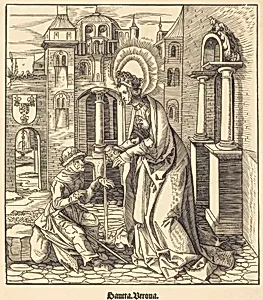
Created by German artist Leonhard Beck between 1516 and 1518, “Saint Verona” is a woodcut that reflects the vibrant tradition of religious printmaking in the early sixteenth century. Beck worked during a period when printed images played a vital role in spreading devotional subjects across Europe, reaching audiences far beyond the walls of churches and private chapels. As a woodcut, the work demonstrates the expressive possibilities of this medium. The artist carved the design into a wooden block, allowing bold lines and textures to convey the saint’s dignified presence. Such prints were prized for their ability to combine clarity with dramatic effect, making them both affordable and visually compelling for collectors and worshippers alike. Now part of the National Gallery of Art’s Rosenwald Collection, this impression preserves an important example of how Renaissance artists used printmaking to celebrate saints and their stories, ensuring these figures remained vivid in the cultural imagination.
About the Artist
Leonhard Beck · 1480–1542
Leonhard Beck (c. 1480–1542) was a prominent painter, draftsman, and woodcut designer active in Augsburg, Germany, during the early Renaissance. Born into an artistic family, he was the son of the miniaturist Georg Beck, with whom he collaborated on two psalters for an Augsburg monastery around 1495. Beck began his training as an apprentice in the workshop of the esteemed Augsburg painter Hans Hol...