
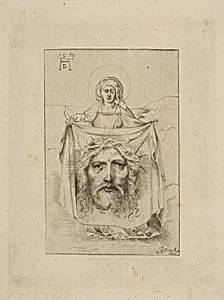
Saint Veronica with the Sudarium
16th century
Dimensions
Sheet: 4 15/16 × 4 1/8 in. (12.6 × 10.5 cm)
Classification
Prints
Department
Drawings and Prints
Museum
Metropolitan Museum of Art, New York, NY
Credit
Fletcher Fund, 1919
Accession Number
19.73.72
Rights
Public Domain
Tags
Art Historical Context
In the intimate world of 16th-century German printmaking, *Saint Veronica with the Sud* stands as a exquisite example of devotional art. Attributed to Sebald Be, with influences from his mentor Albrecht Dürer, small engraving (just 4 15/16 × 4 1/8 inches) captures the legendary saint holding the miraculous Sudarium—the veil bearing Christ's holy face. Veronica, a poignant figure in Christian tradition, is said to have wiped Jesus' brow during his Passion, imprinting his image on the cloth as a divine gift. Beham, a Nuremberg artist and member of the "Little Masters," excelled in intricate engravings like this one, rivaling Dürer's mastery of line and detail on a miniature scale. Produced amid the Reformation's religious fervor, such prints were affordable aids for personal piety, allowing laypeople to meditate on sacred mysteries at home. The work's precision—evident even in its modest dimensions—highlights the era's technical innovation in copperplate engraving, blending realism with spiritual symbolism. Housed in the Metropolitan Museum of Art's Drawings and Prints department (Fletcher Fund, 1919), this piece invites visitors to ponder the enduring cultural power of relics and female saints, bridging Renaissance artistry with timeless faith.
About the Artist
Sebald Beham|Albrecht Dürer · 1500–1550
Sebald Beham (1500–1550), a pioneering German printmaker and painter born in Nuremberg, emerged as one of the most prolific artists of the Northern Renaissance. The elder brother of fellow artist Barthel Beham, he grew up in a milieu steeped in artistic tradition, though details of his early training remain sparsely documented. Recorded as a journeyman painter (Malergeselle) by 1521 and a master w...