
Sainte Julienne de Mont-Cornillon
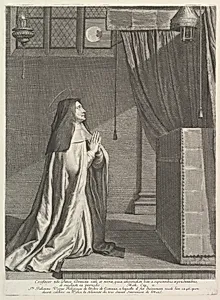
Medium
Etching
Dimensions
sheet: 19 13/16 x 13 5/8 in. (50.3 x 34.6 cm) image: 17 1/16 x 12 1/2 in. (43.3 x 31.8 cm)
Classification
Prints
Department
Drawings and Prints
Museum
Metropolitan Museum of Art, New York, NY
Credit
Harris Brisbane Dick Fund, 1945
Accession Number
45.41.42
Rights
Public Domain
Tags
Art Historical Context
Behold *Sainte Julienne de-Cornillon*, a etching by Jean Morin after a design by Philippe de Champa, housed in the Metropolitan Museum of's Drawings and Prints department. This 17th work captures the revered 13th-century saint Juliana Liège (also known Julienne de Mont-Cornillon), depicted in a moment of deep prayer. Champaigne, a master of French Baroque painting known for his austere religious scenes and portraits, influenced this reproductive print, while Morin, a skilled engraver, brought it to life through intricate etching techniques. Etching, an intaglio method where acid bites into a metal plate to create fine, expressive lines, allowed for detailed reproduction of Champaigne's original vision—likely a painting emphasizing spiritual devotion. Measuring nearly 20 by 14 inches on the sheet, the image (17 by 12½ inches) showcases Juliana's contemplative pose, highlighting her role as a mystic visionary who championed the Feast of Corpus Christi amid medieval Eucharistic piety. This piece reflects the Counter-Reformation era's fervor for saintly imagery, promoting female holiness and prayerful introspection. Acquired through the Harris Brisbane Dick Fund in 1945, it invites visitors to appreciate how prints democratized access to elite art, bridging 13th-century mysticism with 17th-century craftsmanship.
About the Artist
Jean Morin|Philippe de Champaigne · 1605–1650
Jean Morin (c. 1605–1650) was one of the most accomplished French engravers of the seventeenth century, a master of the portrait print whose work stands among the finest examples of French graphic art in its era. Little is known about his early life or training, though his technique suggests exposure to both French and Flemish engraving traditions, the latter being the dominant force in European p...