
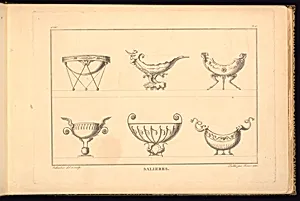
SALIERES
Medium
Classification
Department
Smithsonian Collection
Museum
Smithsonian American Art Museum
Credit
Purchased for the Museum by the Advisory Council
Accession Number
1921-6-404-23
Rights
Public Domain
About this artwork
Research in Progress
Art Historical Context
Henri Sallembier (ca. 1753–1820), a skilled French engraver active during the Napoleonic era, created *Salieres* in 1805. This print, now housed in the Smithsonian American Museum's collection (purchased by the Advisory Council), likely depicts ornate salt cellars—"salieres" in French—elegant tableware symbols of refinement and hospitality. As a reproductive print, it exemplifies Sallembier's expertise in translating designs from paintings or drawings into intricate engravings, a technique that allowed widespread dissemination of luxury motifs. Produced amid France's Empire style under Napoleon, the work reflects the era's neoclassical revival, blending Roman grandeur with functional elegance. Prints like this were vital for architects, silversmiths, and collectors, serving as pattern books for decorative arts. Sallembier's precise line work captured textures and proportions, making high-end designs accessible beyond elite circles. Though research on this piece is ongoing, *Salieres* offers a window into early 19th-century taste, bridging European craftsmanship with American collecting interests at the Smithsonian. Visitors can appreciate how such modest prints fueled transatlantic cultural exchange.