
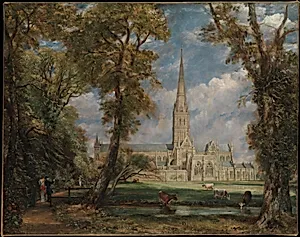
Salisbury Cathedral from the Bishop's Grounds
ca. 1825
Medium
Oil on canvas
Dimensions
34 5/8 x 44 in. (87.9 x 111.8 cm)
Classification
Paintings
Department
European Paintings
Museum
Metropolitan Museum of Art, New York, NY
Credit
Bequest of Mary Stillman Harkness, 1950
Accession Number
50.145.8
Rights
Public Domain
Tags
Art Historical Context
John Constable’s *Salisbury Cathedral from the Bishop’s Grounds* (ca. 1825) invites viewers into a serene English landscape where the towering Gothic cathedral rises behind a gentle foreground of grazing cows and leafy trees. Painted in oil on canvas, the work exemplifies Constable’s deep affection for the countryside of his native Suffolk and neighboring Wiltshire. The inclusion of everyday rural life alongside the historic monument reflects his belief that nature and human achievement could exist in quiet harmony. A leading figure of British Romantic landscape painting, Constable often worked from plein-air sketches before refining his canvases in the studio. Here, his loose yet precise brushwork captures shifting light on stone and foliage, giving the scene a fresh, lived-in immediacy rather than a stiff topographical record. The generous scale—nearly three by four feet—allows the cathedral to feel both monumental and approachable, as if the viewer might step into the bishop’s meadow. Acquired by the Metropolitan Museum through the bequest of Mary Stillman Harkness, this painting remains a beloved example of Constable’s ability to celebrate England’s architectural heritage while grounding it in the rhythms of daily country life.
About the Artist
John Constable · 1776–1837
John Constable (1776-1837) was an English landscape painter whose naturalistic depictions of the Suffolk countryside revolutionized landscape painting and established him, alongside J.M.W. Turner, as one of England's greatest artists. His work pioneered the direct observation of nature that would later influence the French Barbizon school and, ultimately, Impressionism. Born in East Bergholt, Suf...