
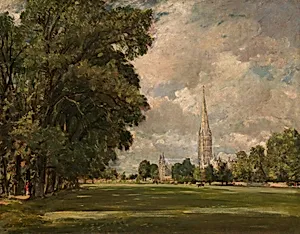
Salisbury Cathedral from Lower Marsh Close
1820
Medium
oil on canvas
Dimensions
overall: 73 x 91 cm (28 3/4 x 35 13/16 in.) framed: 97.1 x 115.6 x 10.7 cm (38 1/4 x 45 1/2 x 4 3/16 in.)
Classification
Painting
Department
CAB
Museum
National Gallery of Art, Washington, D.C.
Credit
Andrew W. Mellon Collection
Accession Number
1937.1.108
Rights
Public Domain
Art Historical Context
John Constable’s *Salisbury Cathedral from Lower Marsh Close* (1820) captures one of England’s most iconic Gothic landmarks nestled within the lush Wiltshire landscape. A leading figure of British Romanticism, Constable devoted much of his career to painting the natural world with deep emotional resonance, elevating everyday scenes of countryside and architecture to the level of high art. This oil-on-canvas view presents the cathedral’s soaring spire from an intimate, ground-level perspective, framed by trees and open meadow, inviting viewers to experience the harmony between human achievement and nature. Constable’s technique shines in his luminous handling of light and atmosphere, achieved through layered brushwork and a fresh palette that conveys the fleeting effects of sun and cloud. Unlike the more formal, topographical views common at the time, his approach emphasizes mood and movement, qualities that would later influence French Impressionists. The painting’s modest scale—roughly 73 by 91 centimeters—further enhances its personal, almost contemplative quality. Today housed in the National Gallery of Art’s Andrew W. Mellon Collection, the work exemplifies Constable’s lifelong fascination with Salisbury, a site he revisited across several canvases. It stands as a quiet celebration of England’s architectural heritage and the enduring beauty of its rural settings.
About the Artist
John Constable · 1776–1837
John Constable (1776-1837) was an English landscape painter whose naturalistic depictions of the Suffolk countryside revolutionized landscape painting and established him, alongside J.M.W. Turner, as one of England's greatest artists. His work pioneered the direct observation of nature that would later influence the French Barbizon school and, ultimately, Impressionism. Born in East Bergholt, Suf...