
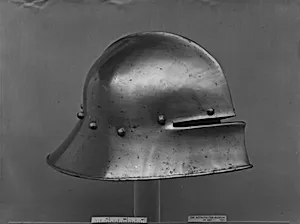
Sallet
Unknown Artist
late 15th century
Medium
Steel, copper alloy, leather
Dimensions
H. 8 1/2 in. (21.6 cm); W. 9 1/8 in. (23.2 cm); D. 15 in. (38.1 cm); Wt. 4 lb. 11 oz. (2126 g)
Classification
Helmets
Culture
German
Department
Arms and Armor
Museum
Metropolitan Museum of Art, New York, NY
Credit
Gift of William H. Riggs, 1913
Accession Number
25.135.62
Rights
Public Domain
Art Historical Context
Step into the late th-century world of German with this striking *S*, a helmet exemplifying pinnacle of medieval armor craftsmanship Originating from Germany during time of intense European conflicts the wars against Burgundy and Ottoman advances—this open-faced helmet was designed for agile combatants, offering vital protection to the head and neck while allowing clear vision and breathability. Its distinctive shape, with a rounded skull, flared visor peak, and extended tail, marked an evolution from earlier bascinets, bridging the gap to fully enclosed Renaissance helmets. Crafted from robust steel with accents of copper alloy and leather fittings, the sallet weighs a manageable 4 pounds 11 ounces, balancing defense against weight for prolonged battlefield use. The materials reflect advanced metallurgical techniques of the era: steel for its superior strength and lightness when tempered, copper alloy for decorative rivets or edging, and leather for comfortable lining and straps. Measuring just 8½ inches high but 15 inches deep, it snugly encased the wearer's head, underscoring the precision engineering of German armorer workshops. A generous gift to the Metropolitan Museum of Art in 1913 by William H. Riggs, this anonymous masterpiece invites us to ponder the human stories behind the steel—the knights, foot soldiers, and mercenaries who donned it in an age when survival hinged on such ingenuity.