
Salomé
1605/10
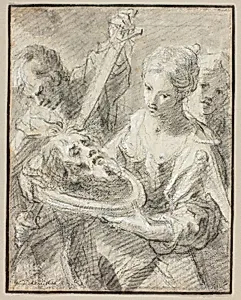
Medium
Black chalk and brush and gray wash, heightened with touches of white gouache, over traces of charcoal, on cream laid paper
Dimensions
18.9 × 14.8 cm (7 1/2 × 5 7/8 in.)
Classification
chalk
Department
Prints and Drawings
Museum
Art Institute of Chicago
Accession Number
111740
Rights
Public Domain
About this artwork
This late drawing reveals the melding of northern and southern Baroque influences that characterized the cosmopolitan court of Holy Roman Emperor Rudolf II (1552-1612). The drawing may relate to a painting of this subject, now lost, that was listed in the Emperor's inventory.
Art Historical Context
**Salomé** by Hans von Aachen created around 1605–1610, is a captivating drawing that exemplifies the artist's mastery during the late Mannerist period. Von Aachen, a prominent German painter and draftsman who served at the imperial court of Rudolf II in Prague, was renowned for his elegant, elongated figures and intricate compositions inspired by Italian masters like Tintoretto and the Carracci. This small-scale work on cream laid paper (18.9 × 14.8 cm) depicts the biblical figure Salomé, likely in a moment of seductive poise, evoking the dramatic story from the New Testament where her dance leads to the execution of John the Baptist. Executed in black chalk and brush with gray wash, heightened with touches of white gouache over faint charcoal traces, the drawing showcases von Aachen's virtuoso technique. These mixed media allowed for subtle tonal modeling, luminous highlights, and a sense of volume on an intimate scale, making it a prized preparatory study or independent sheet typical of the era's courtly ateliers. Housed in the Art Institute of Chicago's Prints and Drawings Department, it reflects the high value placed on such virtuoso drawings among collectors of the time. This piece offers a window into early 17th-century European artistic practice, blending sensuality with narrative gravity, and invites visitors to appreciate the refined beauty of Mannerist draftsmanship up close.