
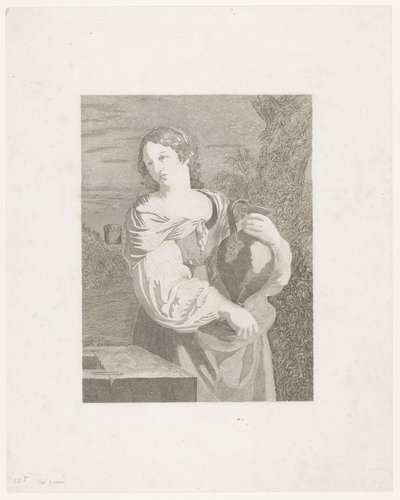
Samaritaanse vrouw bij de waterput
1831 - 1900
Medium
etching
Dimensions
316; 396
Rights
Public Domain
About this artwork
verzamelaarsmerk, verso, gestempeld: Lugt 2228
Art Historical Context
This etching by Jean-Baptiste Meunier (1831–1900) depicts the biblical encounter between Jesus and the Samaritan woman at the well, a story drawn from the Gospel of John. Rendered in the artist’s characteristic line work, the scene captures a quiet moment of dialogue beside the well, emphasizing both the human and spiritual dimensions of the narrative. Meunier, active during the late nineteenth century, was part of a generation of Belgian printmakers who helped revive etching as an independent art form rather than merely a reproductive technique. Etching allowed artists to achieve remarkable tonal subtlety and fine detail through the controlled use of acid on metal plates. At roughly 40 by 32 centimeters, this print balances intimate scale with enough presence to reward close viewing. The presence of the collector’s stamp “Lugt 2228” on the verso indicates that the sheet once belonged to a distinguished private collection, underscoring its appeal to connoisseurs of the period. Today the work offers visitors a window into both the enduring popularity of biblical subjects and the technical sophistication of nineteenth-century printmaking.
About the Artist
Jean-Baptiste Meunier · 1821–1900
Jean-Baptiste Meunier (1821–1900) was a distinguished Belgian painter, draftsman, and engraver whose career exemplified the high technical standards of 19th-century European printmaking. Born on July 28, 1821, in Molenbeek-Saint-Jean (a commune of Brussels) and dying on February 6, 1900, in Ixelles, Meunier was a central figure in Belgian artistic culture, connected to important artistic families ...