
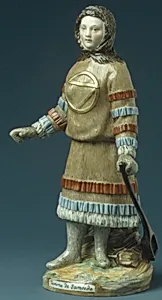
Samoyed Woman
ca. 1780–1800
Medium
Hard-paste porcelain
Dimensions
Height: 8 1/4 in. (21 cm)
Classification
Ceramics-Porcelain
Culture
Russian, St. Petersburg
Department
European Sculpture and Decorative Arts
Museum
Metropolitan Museum of Art, New York, NY
Credit
The Jack and Belle Linsky Collection, 1982
Accession Number
1982.60.166
Rights
Public Domain
Tags
Art Historical Context
Behold the enchanting *Samoyed Woman*, a delicate hard-paste porcelain figurine by the Imperial Porcelainufactory in St. Petersburg around 1780–1800. Standing just 8¼ inches tall, this piece exemplifies the factory's mastery during the late Enlightenment era under Catherine the Great, when Russia celebrated its imperial reach into Siberia and the Arctic. The manufactory, founded in 1744 as a state enterprise, rivaled Europe's finest porcelain centers like Meissen and Sèvres, producing objects for the elite that blended technical innovation with cultural curiosity. Hard-paste porcelain—made from kaolin clay fired at high temperatures—lent the figurine its signature translucency, strength, and pristine white body, ideal for vibrant overglaze enamels and gilding that brought the subject to life. Depicting a woman from the Samoyed (Nenets) people of northern Russia, she reflects the era's fascination with ethnographic diversity, capturing traditional attire amid Russia's expanding empire. Such figures, part of broader tableaus, adorned aristocratic dining tables, merging artistry with subtle imperial pride. Today, housed in the Metropolitan Museum of Art's European Sculpture and Decorative Arts department from the Jack and Belle Linsky Collection, *Samoyed Woman* invites us to ponder how porcelain preserved glimpses of distant cultures, bridging 18th-century opulence with human stories across vast landscapes.
About the Artist
Imperial Porcelain Manufactory, St. Petersburg · 1744–present
The Imperial Porcelain Manufactory in Saint Petersburg, founded in 1744 by Dmitry Ivanovich Vinogradov under the decree of Empress Elizabeth Petrovna, marked Russia's entry into porcelain production as the third such enterprise in Europe after Meissen and Vienna. Vinogradov, a mining engineer educated in Saxony, developed the nation's first hard-paste porcelain formula using local materials, drawi...